Worth saying at the top: we make one of these. Read accordingly.
What follows is the distinction we think actually matters when comparing them, including the cases where the answer is not us.
There are two products wearing the same name
Almost everything marketed as an AI website builder falls into one of two groups, and they solve different problems.
Generators take a description of your business and produce a website. Wix, Squarespace, Hostinger, Framer, Durable and others all offer a version of this. You answer some questions, it assembles pages, images and starter copy, and then you edit what it made in a normal editor.
They are genuinely good at the blank page problem. If you have no site and no idea where to start, thirty seconds of prompting gets you something to react to, which is far easier than starting from nothing.
Operable sites work the other way round. The site is ordinary; what is unusual is that an AI assistant can reach in and work on it whenever you ask. Writing, editing, auditing, publishing. That is the category Swiftrics is in.
The first group answers "how do I get a website." The second answers "who is going to keep this website alive." Most small businesses discover, about four months in, that the second question was the harder one.
The question generators do not answer
Generating a site is the easy part of owning a site.
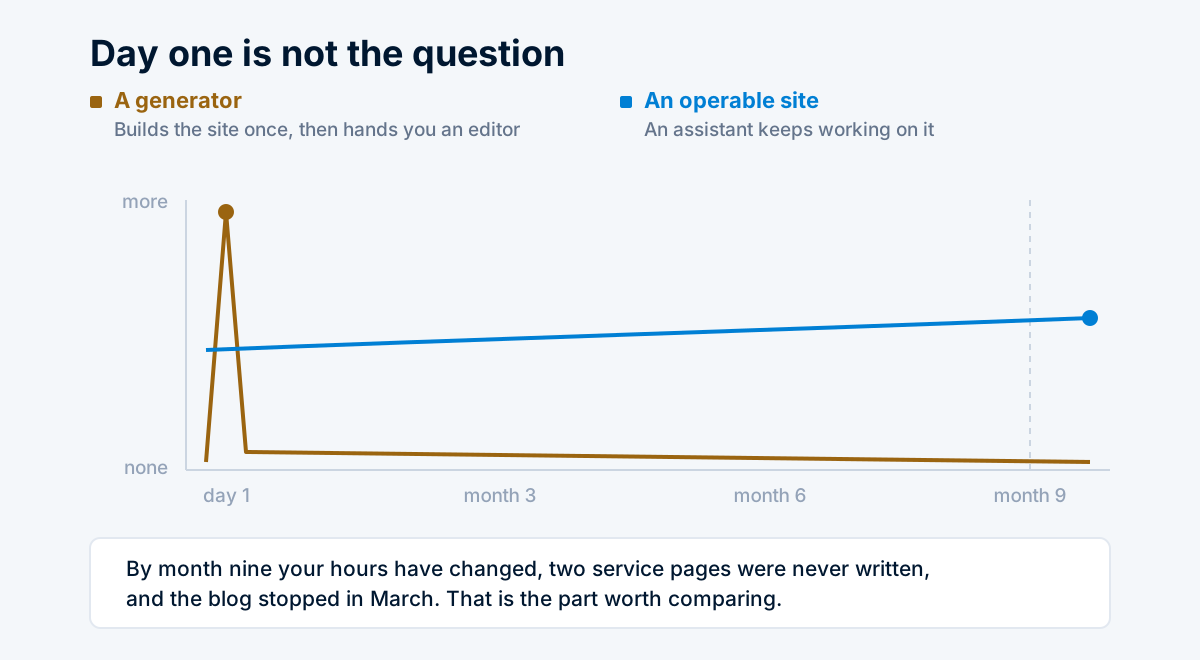
The hard part arrives later. A year on, your hours have changed, two service pages were never written, the blog stopped in March, eleven images have no alt text, and three pages have meta descriptions that say the same thing. None of that is difficult work. It is just work, and it never reaches the top of anyone's list.
A generator does not help with any of it, because the AI was a one-time event at setup. You are back to editing pages by hand, the same as everyone else.
So when you compare these tools, the question worth asking is not "how good is the site it produces on day one." It is "what does this do for me in month nine."
What to actually compare
Does the AI still do anything after setup? For most generators the honest answer is no, beyond text suggestions inside the editor.
Can you take your site with you? Ask whether there is a real export. A platform that will not let you leave is making a bet that you will not want to.
Does it own your domain, or do you? Check whether the domain is included, who it is registered to, and how hard it is to move.
What is the SEO story, really? Meta control per page, sitemaps, structured data, redirects when URLs change. On many platforms some of these are plugins or upgrades. Ask which are included.
How fast are the pages it makes? Generated sites tend to be heavy. Test one on a phone on cellular rather than on your laptop on office wifi.
What happens to the free tier's branding? Free plans usually put the builder's name on your site, and sometimes their ads.
Where free is the right answer
If your business needs one page with an address, hours and a phone number, and you have no intention of touching it again, take a free tier. It will do that job, it costs nothing, and paying us nineteen dollars a month for it would be a waste of your money.
The point where paying starts to make sense is when the site is supposed to bring you work. That means being found in search, loading fast enough that people stay, living on a domain you own, and getting updated more than once a year.
Where Swiftrics fits
We are not a generator. You will not describe your restaurant and watch a site appear in thirty seconds. We have nine templates you pick from and edit, which is a duller answer.
What you get instead is a site an assistant can operate. On the Pro plan you connect Claude to it and it can write your articles, build your service pages, audit every page for SEO problems, read your Search Console data, fix what it finds, and publish. It can do design work through custom templates, not only words. Set the connection up once from a computer and it works from your phone afterwards, which is how most people end up using it.
Two honest caveats. It is in beta: it works and is in real use, and it is young enough that we would rather tell you than have you find out. And it is on our top plan, because it runs on the same API that plan unlocks.
The rest is the ordinary stuff done properly, on every plan: your first domain included, static pages served from a CDN, structured data and sitemaps and redirects built in rather than sold as add-ons, and an export button if you ever want to leave.
We wrote more about the assistant side in connecting an AI to your website.
The short version
If you need a site to exist by Friday and have no starting point, a generator will get you there fastest, and one of the free ones may be all you need.
If you need a site that is still working in two years without becoming somebody's weekend job, pick for month nine rather than day one.