Your portfolio does the selling. Nobody books a photographer from a paragraph.
That makes the website's job narrower than most. Show the work quickly, say what you shoot and where, and make it easy to ask about a date. Everything else is decoration, and decoration is usually what makes photography sites slow.
Photos that load fast on a phone
The thing you sell is also the thing that makes your site slow. A page of camera-original files can take seconds to appear on a phone, and a couple scrolling venues on their lunch break won't wait.
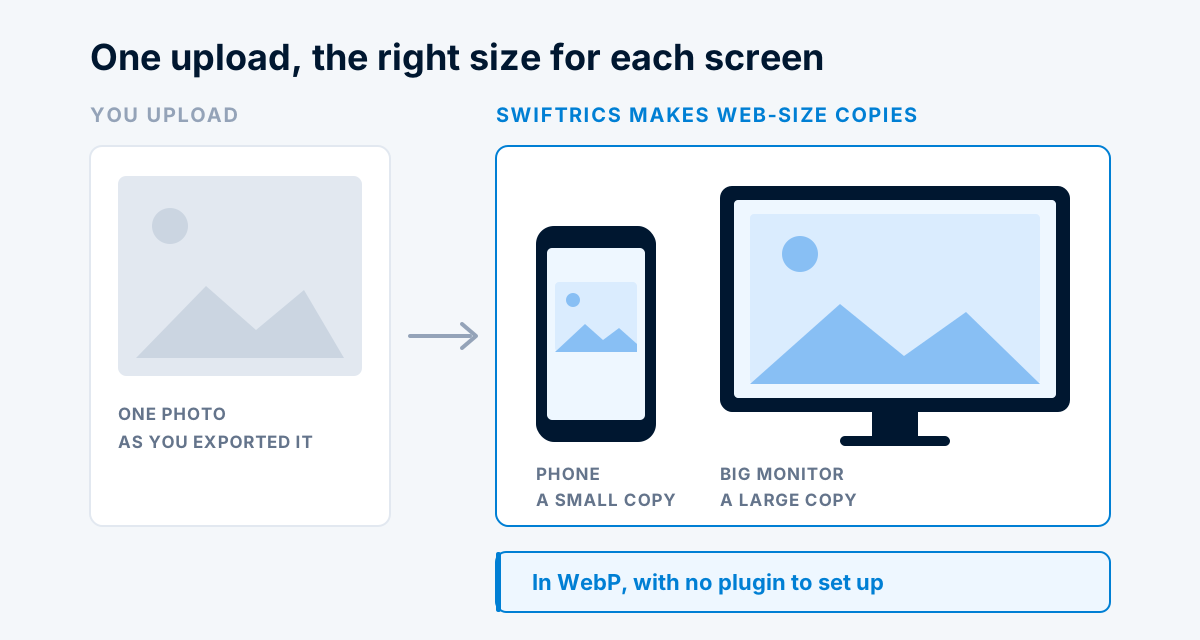
Swiftrics makes web-size copies of your photos in several sizes, in WebP, a format built for the web. A phone downloads a small copy and a big monitor gets a large one, with no plugin to configure.
One habit helps: export at a web size before you upload, around 3,000 pixels on the long edge. It makes uploading quicker. Each file can be up to 50 MB.
Your images get names search engines can read
IMG_4471.jpg tells Google nothing. When Swiftrics makes those web-size copies, it names each file from the alt text you wrote for it, or from the page's headline for the main image. A photo described as "bride and her father on the porch steps" gets those words in its file name.
So write alt text the way you'd describe the frame to someone who can't see it. It does two jobs at once. SEO for photographers covers the rest of this, including why venue pages are the most underused idea in the business.
Say what you shoot, in words
The most common gap on photographer sites is a beautiful portfolio that never names its subject. If you shoot weddings, elopements and family sessions, those words need to be on the page as text. Google can't tell an elopement from an engagement shoot by looking.
Give each kind of work its own page. Name the cities and venues you actually work in. That's most of local SEO for a photographer.
Packages, as text
Put your prices up, even as a starting figure. "Wedding coverage from $2,800 for eight hours" tells a couple whether to keep reading, and it gets found in search. A price hidden behind a contact form never will.
Swiftrics has a block for exactly this: your packages in sections, each with a price written the way you'd say it. "From $2,800" works. "Two hours, $450" works. It publishes as real text, not as an image of a price sheet, and you can change a price yourself in a minute.
Choose a look, and change it later
There are eight built-in templates. On any plan, you can switch to any of them at any time. Your pages and content stay as they are, and the change goes live the next time you publish. The look you pick in your first year isn't the one you're stuck with in your fifth.
What Swiftrics isn't
Swiftrics builds the website that gets you booked. It isn't a client-delivery tool. There's no private proofing gallery for clients and no print store.
If you already deliver through Pixieset, ShootProof or something similar, keep it, and link to it from your site. That split is common anyway: the public website brings in new clients, and the delivery tool handles the ones you already have.
Common questions
What does it cost?
Starter is $19 a month with hosting and SSL, plus a free domain on a standard extension like .com once your trial ends. It has room for 20 pages and 5 GB of photos. If your portfolio is bigger than that, Growth is $39 a month with unlimited pages and 25 GB. Paying yearly costs $190 or $390.
Can I bring my existing site?
If it's on WordPress or Squarespace, the importer brings your pages and posts across. Your old links keep working, because the import writes the redirects for you.
Should I blog my sessions?
Yes, with words. A post with twenty photos and no text does little. The same post with a few paragraphs about the venue, the season and what the day involved is what prospective clients read, and it's what makes the page findable.
Do I still need Instagram?
Keep posting there. Instagram is where people find you. The website is the part you own.
Show the work. Get the booking.
Fourteen day free trial. Your plan isn't charged until it ends.