There are two very different things being sold as AI website tools right now, and the difference matters more than the marketing suggests.
The first is a generator. You describe your business, it produces a website, and then it hands you a normal editor and walks away. The AI part happened once, at the beginning, and after that you are on your own like everybody else.
The second is what we built. Your site is an ordinary Swiftrics site. The difference is that you can connect an AI assistant to it and let it work on the real thing, continuously, for as long as you keep asking.
What "connect" means here
You link an assistant such as Claude to your Swiftrics site. From then on it is not writing text for you to copy and paste somewhere. It is operating the site.
It can create and edit pages, write and publish articles, add locations, read your Search Console data, run the page audit, find what is broken, and fix it. It can build and apply a custom template, which is the part people find least believable until they watch it happen.
The practical difference is the copy-and-paste tax. Most people using AI for their website generate text in one window, paste it into an editor in another, fix the formatting, write the meta description themselves, remember the alt text, and then wonder whether the internal links point anywhere. That whole loop disappears when the assistant has the site.
You do not have to want AI writing your articles
Plenty of business owners do not want a machine writing for them, and that is a reasonable position. It is also not the part of this that gets used most.
The version people reach for daily is much smaller: changing something that is already there.
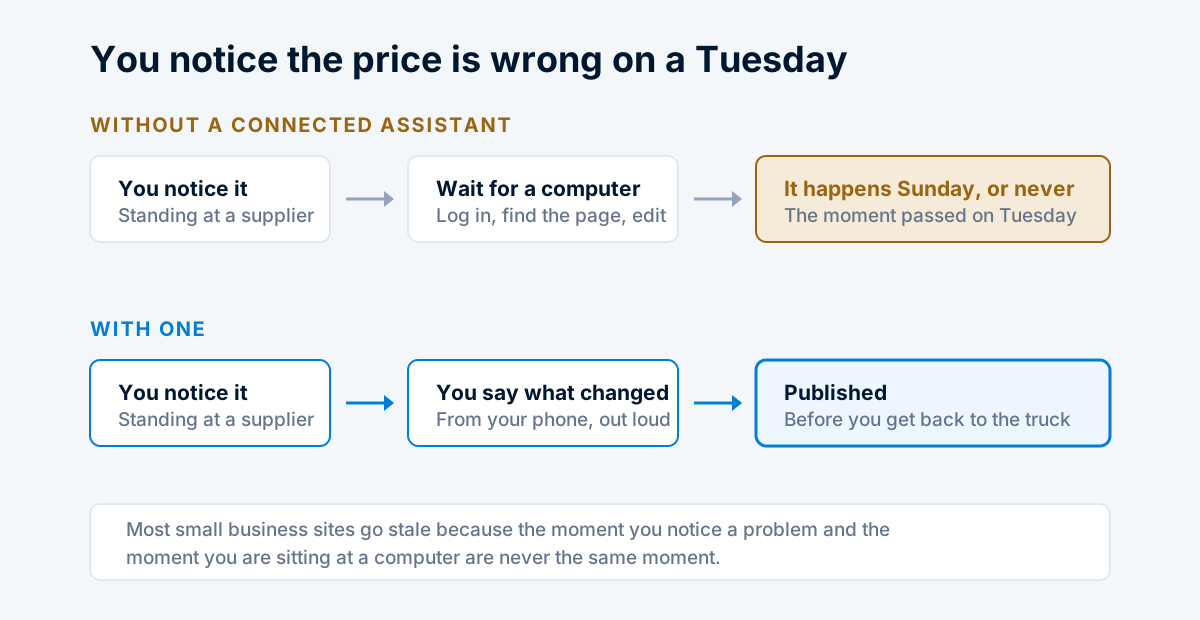
You are standing at a supplier and a price went up. You decide on Tuesday to close early Thursday. A customer mentions your contact page still has the phone number from before you moved. Normally each of those means getting to a laptop, logging in, finding the right page, editing it, and publishing. Which means it happens Sunday night, or it quietly never happens at all.
With an assistant connected to your site, it is a message from wherever you are standing. Tell it the price changed, or that you are closed Thursday afternoon, or that the old number is still on the contact page. It finds the page, makes the change, and publishes.
You set the connection up once, from a computer, and after that it works from your phone as well. That is the difference between a website you maintain and a website you keep meaning to maintain. Most small business sites go stale not because the owner does not care but because the moment they notice a problem and the moment they are sitting at a computer are never the same moment.
The person you were going to pay to do this
A lot of small businesses end up on a support plan. Fifty to two hundred a month to a freelancer or an agency, mostly so that somebody will make small changes when you need them.
The money is usually not the worst part. The loop is.
You notice something on a Tuesday. You write an email trying to explain it: can you move the testimonials above the services section, and make the button say Book a Table instead of Contact Us, and swap the photo at the top for the new one. It gets done Thursday. Two of the three are right. You write another email.
Describing a visual change in words, to somebody who is not looking at it with you and has four other clients, is genuinely hard. Most people are not bad at websites. They are bad at writing a specification, which is a different skill and not one anybody should need.
With an assistant connected to the site you have the same conversation, except it happens now, you can see what changed, and you can say "no, the other photo" without it costing a day. Nothing gets lost in the translation from what you pictured to what you typed, because you can keep talking until it is right.
To be fair about what this does and does not replace: it will not replace a designer doing actual design work, and if you have someone good, keep them. What it replaces is the ticket queue of small changes, which is what most support retainers actually consist of.
What this is good at
The tedious, checkable work. Meta descriptions on forty pages. Alt text on every image. Finding pages with no internal links and adding sensible ones. Auditing every page against a checklist and fixing what fails. This is work that is genuinely boring, genuinely valuable, and almost never gets done on a small business website.
Consistency. A human writing thirty service-area pages gets tired by the eighth. An assistant does not, and it will keep to the same structure and voice across all of them.
Working from your own data. Because Search Console is connected inside the product, an assistant can look at what people actually searched to find you, notice you are sitting at position eleven for something worth having, and go improve that page. That loop, from data to decision to edit to published, happens in one place.
What it is not
It is not autonomous, and we would rather say that than sell you something else.
An assistant working on your site will occasionally be confidently wrong. It will state something about your business that is not quite true, or write a paragraph that reads well and misses the point, or make a claim you cannot back. It does not know that you stopped offering a service last spring unless somebody tells it.
So the model that works is an assistant doing the volume of work and a person deciding what ships. The product is built for that: new pages are created as drafts rather than published, every page keeps its edit history so a change can be reviewed or rolled back, and nothing reaches the live site until a publish runs.
If you want to hand your website to a machine and never look at it again, no honest vendor should sell you that yet. If you want to stop doing the parts of website maintenance you have been avoiding for two years, this works now.
An honest note on its stage
Connect AI is in beta. It works, it is in real use, and it is young. We would rather you knew that going in than discovered a rough edge and felt misled.
Where it sits in the plans
Connect AI is on the Pro plan, at seventy-nine dollars a month.
The reason is mechanical rather than commercial. Connect AI runs on the same API that Pro unlocks: the connector is how an assistant gets told what the API can do. They are one thing, not two, so they share a plan.
That is the honest catch, and it is worth saying plainly. This is the top plan. If what you need is a site you edit yourself a few times a year, Starter at nineteen dollars is the right choice and none of this article applies to you.
Where it starts to pay for itself is if you are already paying somebody a monthly retainer to make small changes, which we broke down in what a small business website actually costs. Seventy-nine dollars against a hundred and fifty dollar support plan is a different arithmetic than seventy-nine against nineteen.
What to actually ask it for
The people who get the most from this treat it like a capable new hire rather than a magic button. Some things worth asking for on day one:
Audit every page and tell me what is failing. Write the four service pages I never got around to. Look at Search Console and find the pages sitting just off the first page. Add a location for the second shop. Go through the blog and fix every missing meta description. Rewrite the About page so it sounds like a person.
Then read what it did before you publish it.
If you are still weighing platforms, we also wrote about how to choose an AI website builder, including when a free one is the right answer.
Fix your website from wherever you happen to be standing
Connect AI is on the Pro plan. Fourteen day free trial.