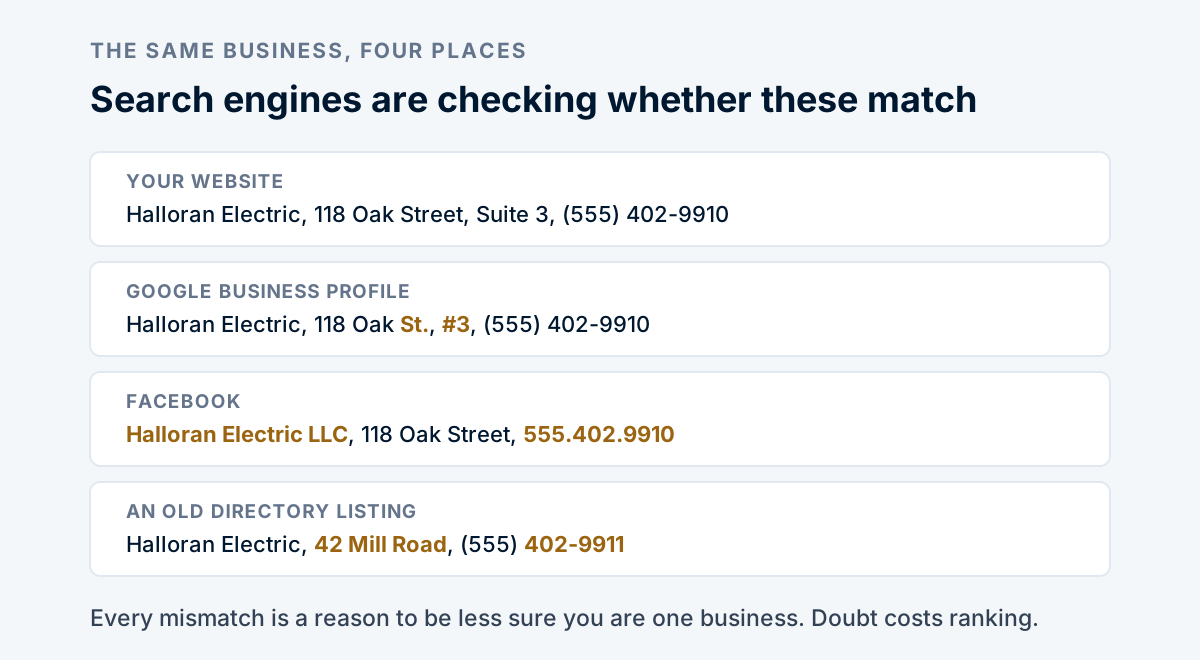
Most local SEO advice is a list of forty things with no indication of which two are worth doing this week. Here they are in order, with the honest note that the first item outweighs everything below it.
1. Your Google Business Profile
If you do nothing else, do this properly.
For a local business, that panel on the right of the search results, the one with your hours, photos, reviews and a map, is worth more than your entire website. Plenty of customers decide from it without ever clicking through.
It is free. Fill in every field. The correct primary category, then the secondary ones that genuinely apply. Real hours, including the holiday overrides. Photos you took recently. Your service area if you travel to customers. The attributes people filter on, like wheelchair access, parking, or whether you take card.
Then keep it current, which is the part that gets skipped. A profile that says you close at five when you now close at seven costs you the last two hours of every day.
2. Name, address, phone, written identically everywhere
This is the least interesting item on the list and one of the most effective.
Your business name, street address and phone number should appear in exactly the same form on your website, your Google profile, your Facebook page, your directory listings, and anywhere else you exist. Same abbreviation of Street or St. Same suite number format. Same phone formatting.
Search engines use the consistency of that information to decide how confident they are that these listings are all the same business. Inconsistency creates doubt, and doubt costs ranking.
On a Swiftrics site you enter these once in your business profile and the site uses them everywhere, including in the machine-readable data search engines read. That removes the most common source of drift, which is one page updated and three forgotten.
3. A page for each place you actually serve
This is where most small businesses have the largest unclaimed opportunity.
One page listing every town you cover will rank for none of them. A page per town, written by somebody who knows the town, can rank for each.
The test of whether the page is any good: could it have been written about anywhere else with a find-and-replace on the town name? If yes, it will not rank, because a search engine can tell the difference between a page about a place and a template with a place name in it.
Write about the actual place. The housing stock. What people there tend to need from you. How long it takes you to get there. What is different about working in that area.
Ten of these beats a hundred thin ones, and they compound. We go into the vertical-specific version of this for trades, real estate agents and contractors, where service-area pages are close to the whole strategy.
It matters less for businesses customers travel to. A dental practice, a salon or a restaurant is competing over one neighbourhood rather than twenty, and the effort is better spent on the profile and the reviews. Law firms, churches and nonprofits each have their own version of the question, and none of them is quite the standard one.
4. Reviews, which you have to earn
Volume, recency and rating all feed local ranking. There is no shortcut worth taking, and the ones on offer will eventually cost you the listing.
What works is asking, in person, at the moment somebody says they are happy. Not a card by the till. A person asking a person. Businesses that do this consistently pull ahead within a couple of months.
Reply to all of them. Reply to the bad ones especially, and reply like a human being rather than a legal department. Prospective customers read the replies more carefully than the reviews, because the replies are where they find out what you are like when something goes wrong.
5. Say what things cost
Not strictly SEO, but it changes what your rankings are worth.
People search locally with an unspoken budget question attached. A page that answers it, even in ranges, even with caveats, converts far better than one that makes them call to find out. Ranking first and converting nobody is a slow way to lose. We take our own advice on what a website costs, for the same reason.
6. Speed, because local search is mobile
Local searches happen on phones, outdoors, on cellular, often from someone who is about to make a decision in the next ten minutes.
A slow page loses them before it has said anything, and what they conclude about you is settled before they read a word. Test yours on a phone on mobile data, not on the office wifi where everything looks fine.
What to skip
Buying directory listings in bulk. The handful that matter are free and you can do them in an afternoon. Paid bulk submission services mostly generate listings nobody reads.
Stuffing your town name into every sentence. It reads badly to people and has not worked on search engines for a long time.
Chasing a keyword you cannot win. If the first page for your main term is three national chains and a directory, the service-area pages in item three are a better use of the same effort.
Some trades break the pattern entirely. Photographers compete on style and portfolio terms more than on geography, and restaurants get most of their return from the profile and a menu that opens on a phone. If your business is one of those, start there rather than here.
If you only have one afternoon
Google Business Profile, completely filled in. Then check your name, address and phone are identical in the four places you already exist.
That is most of the available return, and almost nobody finishes either one.