Someone is standing on a sidewalk two blocks away, deciding where to eat. They have your restaurant's name in their hand and about eight seconds of patience. If your menu does not appear in that window, they are eating somewhere else.
That is the whole job of a restaurant website. Not a slideshow of plated food. Not a splash page with music. A menu, your hours, your address, and a way to book a table, delivered fast on a phone with two bars of signal.
What actually gets used
Restaurant sites tend to be built around what looks impressive on a laptop in the designer's office. The traffic tells a different story. The overwhelming majority of restaurant site visits come from a phone, and they cluster around a handful of questions.
Are you open right now. Where exactly are you. What is on the menu and what does it cost. Can I book a table. Do you deliver.
Everything else is decoration. Useful decoration sometimes, but decoration. Build the five answers first and make them impossible to miss.
Your menu should be text, not a PDF
This is the single most common mistake on restaurant websites, and it costs real money.
A PDF menu forces a download, opens in a separate viewer, renders at the wrong zoom on a phone, and takes a customer out of your site. It also hides your food from search engines. Nobody searching for "carbonara near me" will find a dish trapped inside a PDF.
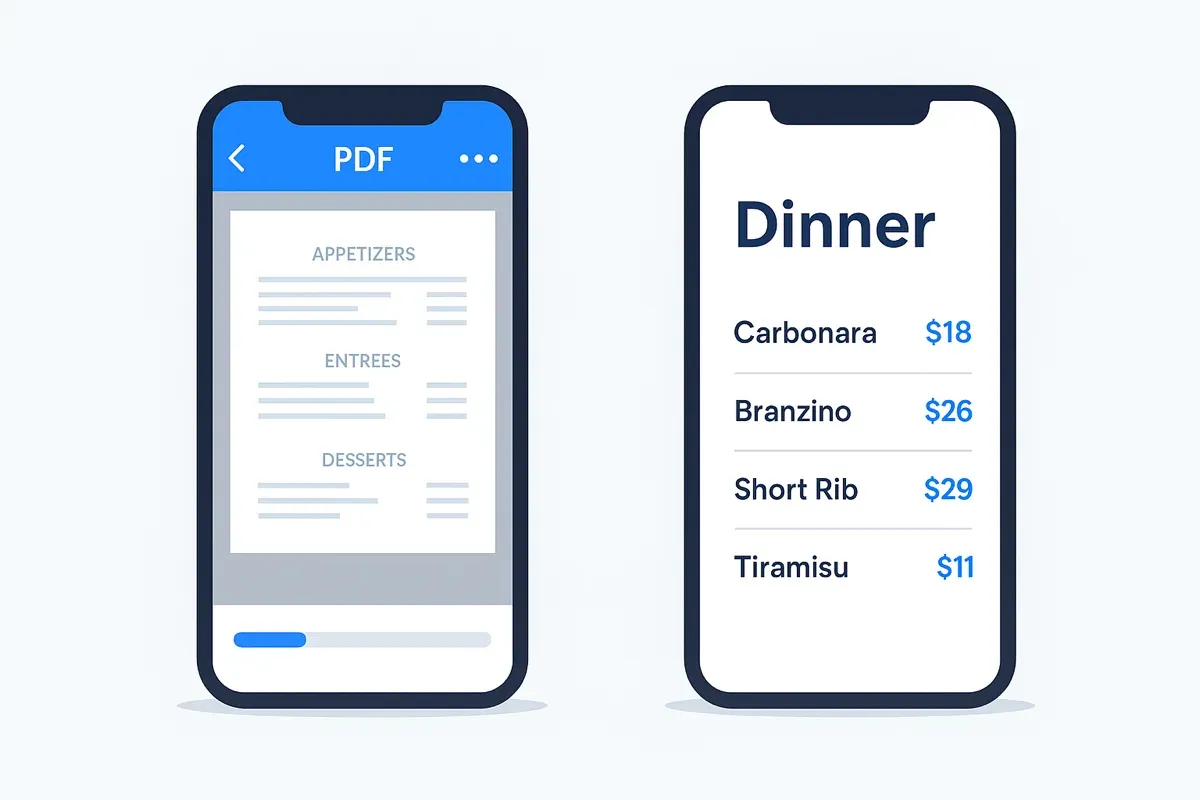
The same goes for a menu saved as a photograph. A screenshot of a menu is invisible to Google, unreadable to anyone using a screen reader, and blurry the moment someone pinches to zoom.
So we built the menu block
Swiftrics has a block for exactly this. You add sections, add dishes under them, and type the price however you actually say it. "Market Price" works. "From $45" works. "$8 / $14" for a half and a full portion works. It does not force your menu into a spreadsheet that cannot describe real food.
What comes out the other side is an ordinary web page: every dish is real text, it resizes to whatever screen is holding it, and it loads instantly.
It also publishes structured data, which is the part worth understanding. Your menu becomes machine-readable, so search engines can recognize it as a menu rather than as a wall of words. A PDF can never do that, and most website builders will happily let you upload one anyway.
Changing a price is a text edit that publishes in about a minute.
Speed is not a technical detail here
Restaurant traffic arrives at the worst possible moment for a slow site. People are outside, on cellular, often downtown where signal is congested, and they are comparing you against two other places with their thumb hovering over the back button.
Swiftrics publishes your site as static HTML on a global CDN. There is no database query, no plugin stack, no server thinking about it. The page is already built and sitting on a server near your customer before they ask for it.
For a restaurant, that difference shows up as people arriving instead of leaving.
Hours that are actually right
Wrong hours on a website generate a specific kind of damage: someone drives to you, finds a locked door, and tells people about it.
Your name, address, hours and phone number go into a business profile once, and the site uses them everywhere they appear, including in the structured data that feeds your listing in search. One edit, not four.
There is also a site-wide banner for the things that do not fit a weekly schedule. Closed for a private event, kitchen shut early on Christmas Eve, patio open again. It appears on every page and turns off in one place.
Getting found by people nearby
Most restaurant discovery is local. Someone searches for your type of food plus a neighborhood, or simply looks for what is near them.
The site side of that comes down to a few things: your name, address, and phone number written identically everywhere they appear, a page that names the neighborhoods you actually serve, your menu as indexable text, and pages fast enough that Google is willing to rank them.
Swiftrics connects to Google Search Console, so the words people actually typed to find you show up in your dashboard rather than in a second tool you have to learn. We wrote a longer piece on all of this in SEO for restaurants.
What you get
Nineteen dollars a month on the Starter plan. That includes your domain, hosting on a global CDN, an SSL certificate that renews itself, the menu block, contact forms, the blog, and the SEO tooling. There is no plugin bill, no separate host, and no security patching to remember.
If you already have a site somewhere else, it can be imported. Point the importer at your current address and it reads the pages, brings them in as drafts, and sets up the redirects so you do not lose the search rankings you already have.
And if you ever leave, you can export the whole site as a zip. It is yours.
Common questions
Can I take reservations through the site?
You can link to whatever booking system you already use, including OpenTable, Resy, or a plain phone number. Swiftrics does not lock you into a particular reservation provider, and does not try to replace one.
What about online ordering?
Same approach. Link out to the ordering platform you already run. Most restaurants already have one through their delivery partners, and pointing at it from a fast site works better than rebuilding it.
Can I update the menu myself?
Yes. That is most of the point. Menu edits are text edits, and they publish in about a minute.
Do I need to know anything technical?
No. If you can write an email you can run the site.
I already have a website. Can I move it?
Yes, and you keep your domain. The importer brings the content across and sets up redirects from the old URLs.
Put your menu somewhere people can actually read it
Fourteen day free trial. Your plan isn't charged until it ends.