The honest answer is that it depends on who you ask, and the range is enormous. The same five-page site for a landscaping company can be quoted at four hundred dollars or fourteen thousand, and both quotes can be given in good faith.
What follows is a breakdown of where the money actually goes, so you can tell which parts of a quote are real.
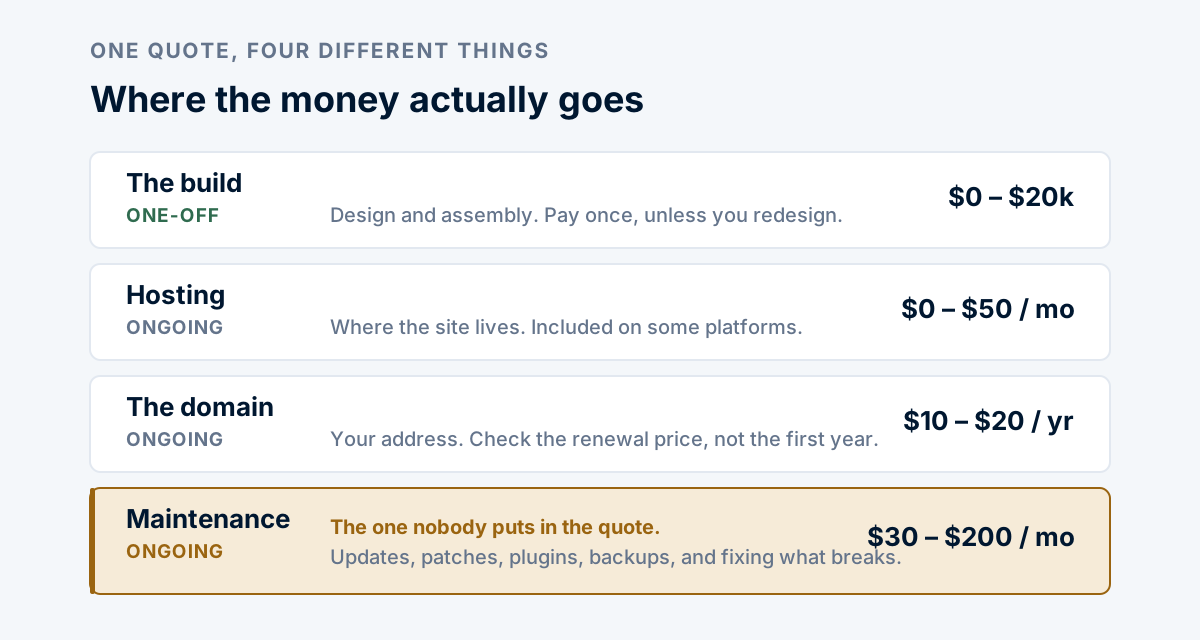
The four costs, separated
Almost every confusing website quote is confusing because it bundles four unrelated things.
The build. Somebody designs and assembles the pages. One-time, unless you redesign.
The hosting. Where the site lives, and what serves it to visitors. Ongoing, monthly or annual.
The domain. Your address. Ongoing, annual, and usually the smallest number on the page.
The maintenance. Updates, security patches, plugin upgrades, backups, and fixing what breaks. Ongoing, and the one most people forget when comparing options.
A quote that gives you a single number without saying which of these it covers is worth a follow-up question.
The domain
Ten to twenty dollars a year for an ordinary .com. Some registrars advertise a first year at one or two dollars and renew much higher, so check the renewal price rather than the promotional one.
Some platforms include one, which removes this line entirely. Ours does. Premium extensions like .io or .ai are their own market and cost what they cost. If you have not picked one yet, choosing a domain name matters less than people fear but is worth doing once, properly.
Hosting
This is where the spread starts.
Shared hosting runs a few dollars a month and is slow under load. Managed WordPress hosting typically runs twenty to fifty dollars a month for a small site. A platform that includes hosting rolls it into the subscription.
The thing worth understanding: cheap hosting is cheap because your site shares a server with hundreds of others. It usually works fine until the day you get real traffic, which is the day you most needed it to work.
The build
Here are the realistic bands you will be quoted for a small business site of roughly five to ten pages.
Do it yourself on a builder, $0 to a few hundred. Your time is the cost, and for a straightforward site that time is a weekend, not a month. If you are going this way, how to choose an AI website builder covers what actually differs between them, including when the free one is the right answer.
A freelancer, roughly $1,000 to $5,000. Wide range depending on where they are and how much of the work is design rather than assembly.
A small agency, roughly $5,000 to $20,000. At the upper end you are buying strategy, copywriting, custom design, and project management, not just pages.
A specialist in a regulated or high-value niche, more. Legal and dental design routinely quote five figures, and some of that premium reflects genuine domain knowledge and some of it reflects what those practices can pay.
None of these bands is wrong. The mistake is paying agency prices for freelancer work, which happens most often when the buyer cannot tell the difference.
Maintenance, the cost nobody quotes
If your site runs on WordPress, something needs updating roughly every week. Core updates, theme updates, plugin updates, and the occasional security patch that cannot wait.
You either do that yourself, pay someone thirty to two hundred a month to do it, or skip it and eventually get compromised. Sites that get hacked are almost never targeted personally; they are found by automated scanners looking for a known vulnerability in an old plugin.
This is the single biggest hidden cost in small business websites, and it is the reason the cheap option often is not. It is also the cost an assistant connected to your site is aimed at, since most support retainers are a queue of small changes rather than design work.
Where Swiftrics lands
Nineteen dollars a month on the Starter plan, thirty-nine on Growth, seventy-nine on Pro. That covers all four costs above rather than one of them.
A standard domain is included, so that annual line disappears. Hosting is S3 and CloudFront, included. The SSL certificate is provisioned and renewed automatically. Maintenance is close to zero, because there are no plugins to update and no database to patch.
The part people underestimate is the SEO tooling, because on other platforms it is a plugin you install, configure, pay for, and then keep updated. Per-page title and description control, a sitemap that rebuilds and resubmits every time you publish, structured data, Open Graph tags for social sharing, internal link suggestions, and a per-page audit that tells you what is wrong before anyone sees it. Contact forms, a media library, and a blog are included rather than bolted on.
We are still not the cheapest option. A free tier from one of the large builders costs nothing and will serve a business that genuinely needs one page with an address on it. The argument for paying starts the moment you want that page to be found, to load fast, to live on a domain you own, and to still work in three years without anybody maintaining it. If that is not what you need, take the free one with our blessing.
What we would tell a friend
If you need a site this month and money is tight, build it yourself on whatever platform you can actually operate. A working site you maintain beats a beautiful one you cannot change. Start with the five pages every small business needs and stop there.
If your website brings in real revenue, paying a good freelancer for design and copy is usually the best money in this whole list. The build is a one-time cost and it compounds for years.
And whatever you choose, find out what maintenance costs before you sign, not eighteen months later when something breaks.